TrueComp

LAUNCHING JULY 2026 · Early access open
TrueComp Intelligence · Know before you hire

The operating system for public sector compensation.

Only 22% of public agencies trust the pay data they use to make million-dollar decisions. TrueComp Intelligence is built for the other 78% — bringing Continuous Compensation Intelligence to the agencies that lead the market: compensation philosophy, AI data ingestion, benchmarking, equity and compression risk detection, and what-if scenario modeling, in one always-on platform. Know before you hire whether the offer you're about to make is competitive — and whether it will quietly create a compression or equity issue the day the new hire starts.

Five questions every agency should be able to answer
Right now. On demand.
  • 1
    Are we currently aligned with our compensation philosophy — or have we drifted?
  • 2
    Where is the highest hidden compression risk in our pay structure?
  • 3
    Which roles are paid outside the equity threshold for their peer group?
  • 4
    If we make this market adjustment or extend this offer to a new hire, what equity and compression issues does it create downstream?
  • 5
    Is our Job Description up to date and does it accurately reflect the duties and requirements of the job?
78%
Of agencies don't trust their pay benchmarks
18%
Of agencies feel their job descriptions have been modernized
Real-time
Continuous refresh, not annual snapshots
The problem we solve

Existing tools tell you what happened yesterday.

TCI tells you where you stand right now — and warns you what's coming before it costs you. Compression hiding in a pay structure. Equity drift across peer groups. A new hire's offer that's about to create a structural problem the day they start. A market adjustment that will quietly break the bands you've spent two years defending.

Public agencies make multi-million-dollar workforce decisions on data they privately doubt. TrueComp Intelligence changes that — combining philosophy definition, AI-based data ingestion, real-time benchmarking, and predictive scenario modeling into a single continuous, always-on platform built exclusively for government.

TrueComp Intelligence is an exciting new solution from the market leader in public sector compensation data. Coming July 2026.

01Compensation Philosophy Definition

Turn your compensation philosophy into a living operating system.

Most agencies have a compensation philosophy document sitting on a shared drive — written once, referenced rarely, enforced never. TrueComp Intelligence operationalizes your philosophy: define your target market position, at the agency level, and the platform checks every decision against it continuously.

Why it matters
Without data, a compensation philosophy is just a statement. With TCI, it becomes a defensible framework — a reason to say "no" to arbitrary demands and "yes" to necessary adjustments, with a single stated target you can point to in every conversation.
What it does
  • Define your agency's target market position — e.g., "our philosophy is to pay at the 60th percentile of total compensation against our defined peer group."
  • Continuously measures actual pay against that target so you see drift in real time, not three years later in a consultant's report.
  • Automatic philosophy drift alerts fire when the agency's position moves outside the target band you've set.
  • Pre-decision philosophy check — before any pay change is finalized, the platform checks it against your philosophy and flags anything that would push you further from target.
  • One stated target, one source of truth — HR, Finance, elected officials, and the bargaining table all working from the same documented strategy.
Example
Your philosophy says "target the 60th percentile of total compensation." Six months after adoption, market shifts have drifted your overall position to the 52nd percentile. TCI flags it — not in next year's audit, but the week the drift crosses the threshold.
Want to see this in action? See a Demo
02AI-Based Data Ingestion

Bring your data as you have it. We do the rest.

No agency keeps salary schedules, job descriptions, MOUs, benefit summaries, and cost records in a single clean format. They're spread across PDFs, spreadsheets, Word docs, and scanned attachments — produced by different departments at different times. TCI's advanced AI reads them all, extracts the components the platform needs at high accuracy, and turns your raw source files into structured data — ready to use.

Why it matters
The 22% problem isn't abstract. When 78% of HR leaders doubt their benchmarks, a lot of that doubt traces back to data quality — which starts with how the data got into the system. TCI removes the re-keying, the format conversion, and the months of implementation pain by letting you load what you already have.
What it does
  • Accepts your data in whatever format you already have it — salary schedules, job descriptions, benefit summaries, MOU documents, cost records, and more. No reformatting required.
  • Advanced AI extraction pulls the specific fields the platform needs (classifications, pay ranges, benefit values, MOU terms, cost components) out of unstructured source files with high accuracy.
  • Handles mixed inputs — a PDF salary schedule, an Excel cost summary, a Word MOU, and a scanned benefit document can all be ingested in the same workflow.
  • Faster implementation — drastically reduces the weeks of manual data prep that traditionally front-load any workforce analytics rollout.
Example
Your HR team sends in a PDF salary schedule, an Excel benefit summary, three Word-formatted MOUs, and a scanned classification plan. TCI reads all six, extracts the pay ranges, benefit loads, and classification structures, and has your data ready to use — without your team re-keying any of it into a template.
Want to see this in action? See a Demo
03Unlimited Comparator Selection

Build the peer group that actually reflects your agency.

Averages from a vendor-chosen peer list are dangerous liars. TCI lets you build as many comparator cohorts as you need, selected by the criteria that matter most for public sector benchmarking: geographic radius, state, and population size.

Why it matters
Your comparator set is the most defensible element of any compensation decision. When a council member challenges a number, "we used the same 10 agencies every other city uses" isn't an answer. TCI lets you walk in with a cohort you can explain, justify, and adjust.
What it does
  • Unlimited flexibility to select comparator sets by job — to ensure you have the right amount of relevant data for any compensation decision.
  • Select by radius — pull agencies within a defined distance of your location, so your cohort reflects your actual labor market.
  • Select by state — build state-specific cohorts that reflect the same regulatory, pension, and labor environment.
  • Select by population size — compare against agencies of similar scale, scope, and operating complexity.
  • Defensible methodology — operating from your defined compensation philosophy, with a clear comparator rationale, lets you better defend pay decisions to councils, unions, and auditors.
Example
You build a cohort of cities within 200 miles, in your state, with populations between 80,000 and 150,000. Every benchmark, market summary, and scenario you run against that cohort reflects agencies that actually look like yours.
Want to see this in action? See a Demo
04AI Job Matching & TrueComp Job Taxonomy

Apples-to-apples benchmarking, even when the titles are chaos.

A "Management Analyst" in one city does the work of an "Administrative Assistant II" in another — and a "Program Coordinator" somewhere else. Title drift across jurisdictions destroys benchmarking accuracy unless you solve the matching problem at its root. TCI solves it with a proprietary job taxonomy and AI-powered matching.

Why it matters
Bad job matching is the silent killer of every benchmarking report. When your "Planner II" is matched to the wrong peer role, every downstream number — pay range, equity finding, scenario cost — is quietly corrupted. The taxonomy fixes that at the foundation.
What it does
  • Proprietary TrueComp Job Taxonomy — a public-sector-specific classification system organizing roles by actual function, not title.
  • AI-based matching reads your current job descriptions and titles, maps them to the correct taxonomy code automatically.
  • Handles cross-jurisdiction title drift — knows that a "Senior Civil Engineer" in one city may be a "Principal Engineer" in another.
  • Confidence scoring on every match — flags ambiguous or low-confidence matches for your review.
  • Taxonomy-driven benchmarking — once matched, every comp comparison runs against taxonomy peers, not title peers.
Example
Your agency has 340 unique job titles across 11 departments. TCI's AI maps each to a taxonomy code instantly — identifying, for instance, that your "Clerk III," "Administrative Specialist," and "Department Coordinator" all map to the same taxonomy role. One consolidated benchmark, three defensible pay grades.
Want to see this in action? See a Demo
05Compensation Benchmarking

Role-level market position, continuously refreshed.

TCI's benchmarking runs on real-time, government-only data — not the static, private-sector-inclusive surveys that produce averages you can't defend. Every role, every classification, every percentile is live. Powered by industry-leading AI-based job matching, your benchmarks reflect the real market — refreshed continuously.

Why it matters
Traditional benchmarking studies cost $50K+ and are stale the day they're delivered. TCI replaces the snapshot with a continuous feed — and replaces aggregate averages with role-level precision.
What it does
  • Role-level, not aggregate — averages are dangerous liars; TCI benchmarks the actual role, not a department-wide mean.
  • Total compensation view — base + benefits + special pay + retirement + incentives, all in one number.
  • Market positioning at 25th, 50th, 75th percentile — and any custom percentile your philosophy requires.
  • Continuous refresh — as comparator data updates, your benchmarks update. No annual cycle.
  • Government-only data — no private-sector noise polluting your peer comparisons.
Example
Council member in the budget hearing: "Are we competitive for a Senior Engineer?" Your answer, live from TCI: "As of this month, we're at the 48th percentile on base, but 62nd percentile on total comp. Three comparator agencies raised base pay in March; we've drifted 4 points since."
Want to see this in action? See a Demo
06Market Summary

A single, unified view of where your agency stands.

The Market Summary is your competitive dashboard — a continuously updated, single-screen view of how your entire workforce compares to the market, with philosophy alignment at a glance. Swap your comparator cohort on the fly to see how your position changes against different peer groups, without leaving the screen.

Why it matters
You can't manage what you can't see. When a leader needs a status update — on a council agenda, a board review, a budget meeting — the Market Summary replaces two days of analyst prep with a screen you can walk into any meeting with.
What it does
  • Live positioning dashboard — every classification, every department, every percentile in one view.
  • Philosophy alignment overlay — see at a glance which roles are on-target and which have drifted outside your philosophy band.
  • Real-time comparator selection — switch your comparator list on the fly and watch positioning recalculate immediately, so you can see how your standing changes across different peer definitions.
  • Board-ready export — clean, presenter-ready visuals for councils, boards, and executive meetings without reformatting.
Example
In a council meeting, a member asks: "What if we compared ourselves only to cities over 100K instead of our normal cohort?" You swap the comparator list in the Market Summary, and the positioning recalculates instantly — showing your position shift from the 54th percentile to the 47th percentile against the new peer set, right there on the screen.
Want to see this in action? See a Demo
07AI Job Description Optimization

Modernize decades-old JDs in days, not quarters.

In most public agencies, job descriptions are years — sometimes decades — out of date. Every benchmark, every equity analysis, every scenario model built on a stale JD is structurally unsound. TCI's AI-powered optimization modernizes your JDs by comparing them against taxonomy peers in the database and ONET best practices.

Why it matters
Garbage JDs produce garbage compensation decisions. Outdated requirements cause candidates to self-select out. Wrong complexity levels produce wrong grade placements. TCI fixes the foundation every other capability depends on.
What it does
  • Benchmarks your JDs against taxonomy peers — compares your current description against how leading agencies describe the same role.
  • Incorporates ONET best practices — pulls in the Department of Labor's occupational standards to suggest modernized language, competencies, and requirements.
  • Surfaces outdated language and missing competencies — flags requirements no longer standard, highlights modern skills your JD doesn't mention.
  • Generates suggested rewrites — full draft revisions you can accept, edit, or reject, not just a red-pen review.
  • Feeds directly into better benchmarking — optimized JDs produce more accurate taxonomy matches, which produce more accurate benchmarks.
Example
Your IT Manager JD was last updated in 2013. TCI compares it against 80 peer-agency IT Manager JDs and ONET's current standards — surfacing that your JD is missing cybersecurity responsibilities, references deprecated platforms, and lacks cloud competencies every peer agency now requires. You modernize it in an afternoon.
Want to see this in action? See a Demo
08Pay Compression Risk Detection

Find the compression hiding in your pay structure.

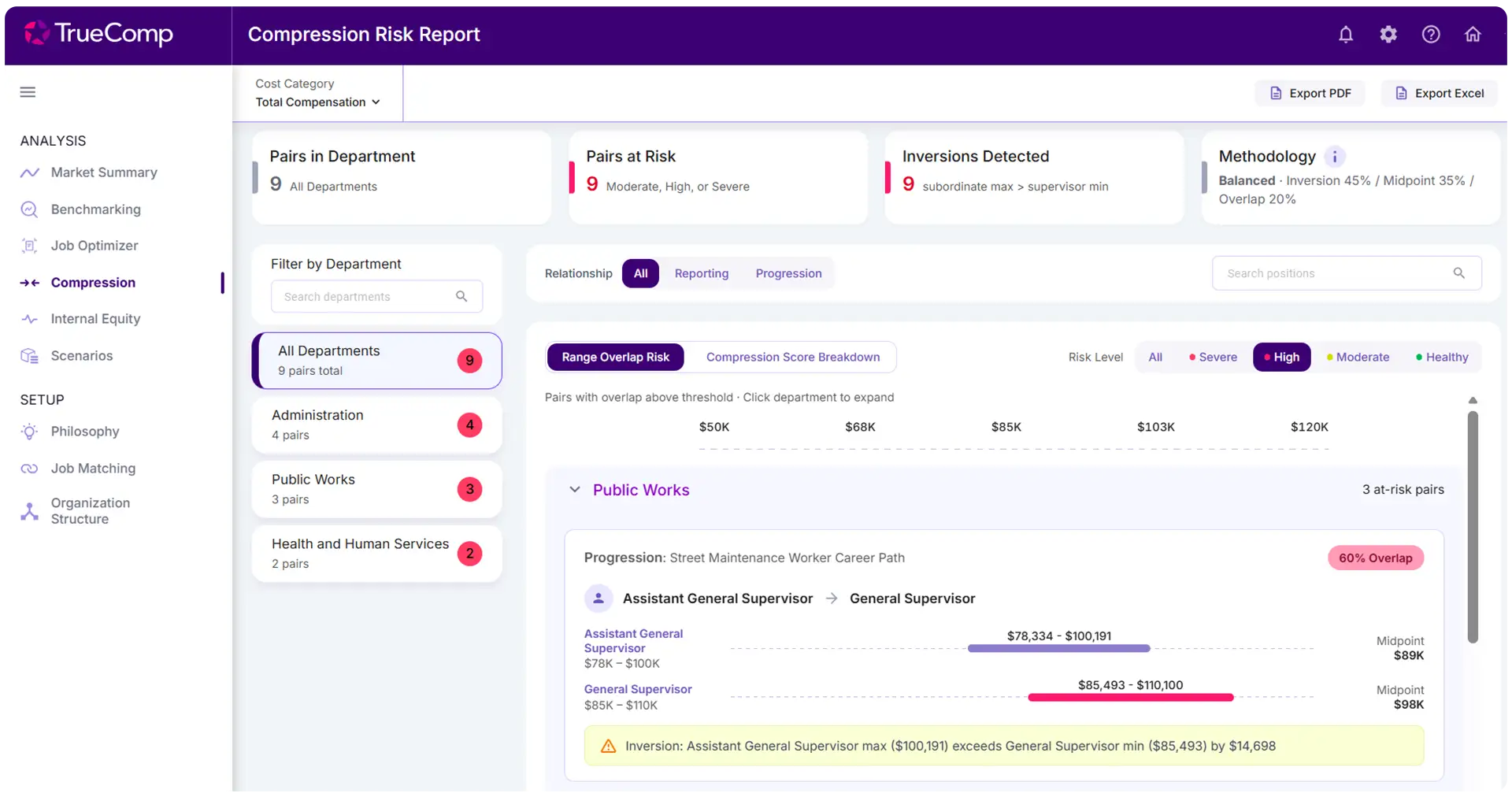
Pay compression — where the differentials between classifications, grades, and steps narrow or invert — is a silent culture destroyer. TCI analyzes your positional pay structure (classifications, grades, steps, and the relationships between them) to surface compression risk continuously, not just during periodic audits.

Why it matters
Structural compression is usually discovered after the damage is done — when a senior leader quits because a new hire is paid too close to their number. TCI reverses the sequence: you see the structural risk in your pay plan first, and can fix it before it shows up as turnover.
What it does
  • Continuous scanning of your positional pay structure — analyzes the differentials between classifications, grades, and steps to identify where structural compression exists.
  • Compression risk flagged at the structural level — surfaces classifications, grades, or step relationships where the spread has narrowed below a healthy threshold.
  • Leapfrog effect detection — catches when the pay structure places a subordinate classification above a supervisory one, inverting the hierarchy.
  • Supervisor squeeze alerts — flags where the differential between supervisor and direct-report classifications has compressed to a level that creates a promotion disincentive.
  • Pre-decision compression check — before any pay change is finalized, TCI shows the compression impact on the pay structure it would create.
Example
You're considering a market adjustment to the Planner classification. TCI's pre-decision check flags that the proposed change would compress the differential between Planner and Senior Planner to under 6% — a structural squeeze. You see the issue before the change is approved, not months later when promotions stall.
Want to see this in action? See a Demo
09Internal Equity Risk Identification

Surface internal equity issues before they become grievances.

Similar roles across departments — with similar requirements and duties — should be paid equitably. TCI automatically groups similar roles into peer groups and flags any jobs that fall outside the threshold you've set, so internal pay inequities surface as risks, not as grievances.

Why it matters
Internal equity issues don't announce themselves. They surface in grievances, morale problems, and quiet resignations — long after they became expensive to fix. TCI surfaces them while they're still correctable, before they become a crisis.
What it does
  • Automatic peer group formation — groups jobs across departments and divisions that share similar requirements, duties, and scope.
  • Threshold-based equity checking — you define the acceptable pay range within a peer group (e.g., "all jobs in this peer group should be paid within ±10% of the group midpoint").
  • Continuous equity monitoring — any job that falls outside the defined threshold is flagged as a potential internal equity issue.
  • Pre-decision equity check — before any pay change, promotion, or reclassification, TCI shows whether the change would push a job inside or outside the peer group threshold.
  • Surfaces equity drift — as market adjustments and individual changes accumulate, TCI watches for peer groups that have slowly drifted apart.
Example
Your peer group for "Senior Analyst" includes roles in HR, Finance, IT, and Planning — all with similar education requirements, scope of responsibility, and supervisory expectations. TCI flags that the IT Senior Analyst is paid 14% above the peer group midpoint while the HR Senior Analyst sits 12% below — outside your ±10% threshold. An internal equity issue you can correct proactively, not after a grievance.
Want to see this in action? See a Demo
10What-If Scenario Modeling

See the downstream consequences of every pay decision.

Public agencies make pay decisions all the time — market adjustments, reclassifications, promotion structures, equity remediations. The consequences of those decisions aren't always visible in the decision itself. TCI's What-If Scenario Modeling lets you model adjustments in advance, see the downstream equity and compression effects, and build a final scenario you can hand to stakeholders as a reviewable report.

Why it matters
The consequences of a pay decision aren't always visible in the decision itself. TCI lets you evaluate those consequences up front — so you can get in front of downstream equity and compression issues before they become retention problems or the next budget cycle's surprise.
What it does
  • Model pay changes for philosophy compliance — simulate adjustments designed to bring your agency in line with the target market position you've defined.
  • Downstream equity impact — every modeled change shows which peer groups would be pushed outside your defined equity threshold as a result.
  • Downstream compression impact — every modeled change shows the structural compression it would create in your pay plan.
  • Before/after analysis of the affected cohort — side-by-side view of the jobs in scope, showing current state and post-scenario state.
  • Scenario adjustment builder — iterate on your proposed change set, testing combinations of adjustments until you find a scenario that moves you toward philosophy compliance without creating new problems.
  • Stakeholder-ready report output — produce a report of the final scenario you can review with HR leadership, Finance, councils, and boards.
Example
You're modeling a market adjustment for your engineering classifications to move closer to your 60th-percentile target. TCI shows that the adjustment closes the philosophy gap but creates a compression flag between Senior Engineer and Engineering Manager, and pushes two related Senior Analyst peer groups outside your equity threshold. You iterate the scenario — adjusting the Manager grade and the related Analyst classifications — until you have a final scenario that's philosophy-compliant, equity-safe, and structurally sound. Then export the report.
Want to see this in action? See a Demo

Get a demo of TrueComp Intelligence today.

Find out for yourself what public sector HR and Finance professionals across the country can't wait to get their hands on!